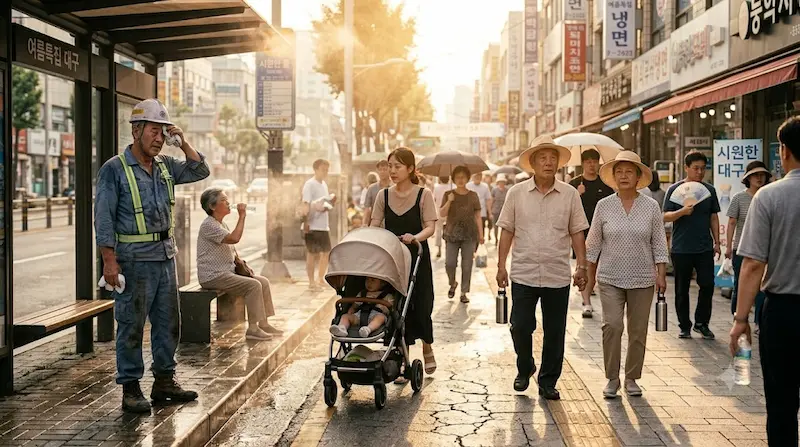
Knowing how to tell heat exhaustion from heat stroke can save a life. Last week in my supplement store in South Korea, a regular customer walked in shaken. Korea’s summer this year has been brutal, but he was telling me about Europe, and his body was telling me the same thing customers have been telling me for the last three summers: heat is killing more people every year than hurricanes, floods, and tornadoes combined.
Extreme summer heatwaves are becoming more frequent and intense across the globe. Europe has seen record-breaking temperatures in recent summers, but the same story is now unfolding in Southeast Asia, parts of Africa, and South America. As temperatures rise to unprecedented levels, staying outdoors for extended periods poses severe health risks that people of every age underestimate — from young athletes practicing in the morning sun, to office workers walking home in the afternoon, to grandparents sitting quietly in apartments without air conditioning.
Understanding the specific warning signs of heat-related illnesses can prevent a mild health issue from turning into a life-threatening crisis. Two of the most common conditions you must look out for are heat exhaustion and heat stroke.
While both illnesses are caused by the body’s inability to cool itself down, they differ significantly in severity and required medical action. Failing to recognize the transition from heat exhaustion to heat stroke can have devastating consequences for anyone — a healthy twenty-year-old on a construction site, a pregnant woman waiting for a bus, or an elderly relative who no longer feels thirst the way they used to.
Understanding Heat Exhaustion and Its Common Warning Signs
Heat exhaustion is the body’s natural response to an excessive loss of water and salt, usually through profuse sweating. This condition typically develops after prolonged exposure to high temperatures, often accompanied by physical exertion or dehydration.
Identifying the Symptoms of Heat Exhaustion
The primary indicator of heat exhaustion is heavy sweating as your body desperately attempts to lower its core temperature. This intense sweating is almost always accompanied by a feeling of severe dizziness, general weakness, or lightheadedness.
As the condition progresses, you may experience a rapid pulse, muscle cramps, headache, and nausea. Your skin might feel cool and clammy to the touch, despite the high external temperature around you. Muscle cramps in the legs are often the first sign that electrolytes are running low — a warning I have personally ignored twice, both times ending in a very unpleasant afternoon on the couch.
Immediate First Aid for Heat Exhaustion
If you or someone else displays signs of heat exhaustion, it is crucial to move to a cooler, shaded, or air-conditioned environment immediately. Loosen any tight clothing and apply cool, wet cloths to the skin or take a cool bath to lower the body temperature.
Hydration is vital at this stage, so drink cool water or drinks containing electrolytes slowly. Plain water alone is often not enough, because sodium and magnesium losses through sweat need to be replaced as well. If you want a deeper look at how magnesium loss affects muscle cramps and recovery, I covered that in my earlier article on magnesium citrate versus glycinate.
If the symptoms worsen or do not improve within an hour, seek professional medical evaluation without delay.
Recognizing Heat Stroke as a Severe Medical Emergency
Heat stroke is the most serious heat-related illness and occurs when the body’s temperature regulation system fails completely. When this happens, the body’s core temperature can spike to dangerous levels within minutes, posing an immediate threat to life.
The Critical Signs of Heat Stroke
A key differentiator for heat stroke is a dangerously high body temperature, according to the CDC typically reaching or exceeding 103°F (39.4°C). Unlike heat exhaustion, a person suffering from heat stroke may have hot, red, dry skin, indicating that the body has stopped sweating entirely.
Neurological changes are the most alarming indicators of heat stroke. Patients often exhibit profound confusion, altered mental states, slurred speech, delirium, or even a complete loss of consciousness. Family members sometimes mistake sudden confusion in an older relative for a stroke or the onset of dementia — do not wait to find out which one it is. Call for help.
Emergency Actions Required for Heat Stroke
Heat stroke is a strict medical emergency that requires immediate professional medical intervention. If you suspect someone is suffering from heat stroke, call local emergency services instantly.
While waiting for medical professionals to arrive, move the person to a cooler area and attempt to cool them down using any available means. You can douse them with cool water, ice packs, or place them in front of a fan, but do not give them anything to drink if they are confused or unconscious.
Key Differences Between Heat Exhaustion and Heat Stroke
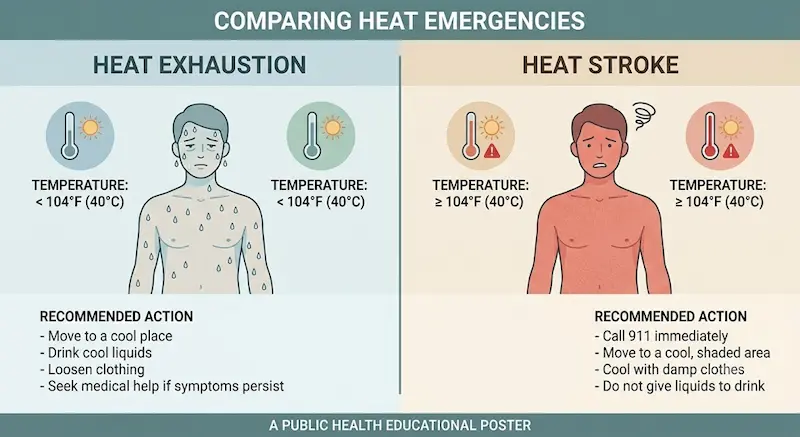
Knowing how to tell heat exhaustion from heat stroke is essential because the two conditions require very different responses.
Distinguishing between heat exhaustion and heat stroke is essential for determining the appropriate level of urgency and care. Knowing what to look for allows you to make split-second decisions that can save a life during a heatwave.
Symptom Comparison and Urgency Checklist
The following breakdown highlights the distinct physiological differences between the two conditions:
Skin Condition: Heat exhaustion presents with cool, pale, and clammy skin with heavy sweating. Heat stroke presents with hot, red, and either dry or damp skin without active sweating.
Mental State: Individuals with heat exhaustion remain alert and conscious despite feeling dizzy. Individuals with heat stroke experience severe confusion, agitation, and possible fainting.
Body Temperature: Heat exhaustion temperatures are usually under 103°F (39.4°C). Heat stroke temperatures rapidly climb above 103°F (39.4°C).
Pulse Rate: Heat exhaustion causes a rapid but weak pulse. Heat stroke causes a rapid and remarkably strong, bounding pulse.
When to Pivot from Home Care to Emergency Medical Aid
You must escalate the situation to emergency services if home cooling methods fail to bring relief. If vomiting occurs, or if the individual’s mental state begins to deteriorate into confusion or lethargy, stop home care and seek emergency help immediately.
Who Is Most Vulnerable During a Heatwave

Some bodies handle heat better than others — check on the ones who cannot check on themselvesLearning how to tell heat exhaustion from heat stroke is especially important for vulnerable groups who face higher risks during extreme heat.
Heat can strike anyone, but certain groups are at significantly higher risk and deserve extra attention during extreme temperatures.
Infants and Young Children whose small bodies heat up three to five times faster than adults and who cannot communicate distress clearly.
Pregnant Women who carry a higher core temperature and are more prone to dehydration.
Outdoor Workers such as construction workers, farmers, and delivery staff whose jobs cannot pause for the weather.
Athletes and Fitness Enthusiasts who often push through early warning signs during summer training.
People with Chronic Illness including those with heart disease, diabetes, kidney disease, or respiratory conditions.
People Taking Certain Medications especially blood pressure pills, diuretics, antihistamines, and some antidepressants that impair the body’s cooling response.
Older Adults who lose the ability to sense thirst as sharply, sweat less efficiently, and often live alone without anyone checking in during the hottest hours. In Europe’s 2003 heatwave, tens of thousands of elderly deaths occurred quietly — people simply did not call for help. The same pattern has repeated in every major heatwave since, from India to the American Southwest.
If you have a parent or grandparent living alone, a phone call in the afternoon costs nothing. It can save a life.
Effective Prevention Tips to Stay Safe in Extreme Heat
Preventing heat-related illnesses is entirely possible with proactive planning and situational awareness during hot summer days. Modifying your daily routine during peak temperature hours significantly reduces your risk of overheating. This applies whether you are in Southern Europe, Southeast Asia, sub-Saharan Africa, or South America — the physiology of heat stress is the same everywhere, only the timing of the season changes.
Smart Hydration and Clothing Choices
Staying properly hydrated is your first line of defense against both heat exhaustion and heat stroke. Drink plenty of fluids throughout the day, focusing on water and electrolyte-rich beverages while avoiding alcohol and excessive caffeine, which accelerate dehydration.
Wear loose-fitting, lightweight, and light-colored clothing to allow your body to breathe and cool down naturally. A wide-brimmed hat and sunscreen are also essential to protect your skin from direct solar radiation, which increases internal heat absorption.
Scheduling Activities and Finding Cool Environments
Limit strenuous outdoor activities, exercises, or heavy labor to the cooler parts of the day, such as early morning or late evening. If your home lacks air conditioning, spend the hottest hours of the afternoon in public spaces like libraries, shopping malls, or community cooling centers.
Keep a close eye on vulnerable populations, including the elderly, young children, and individuals with chronic medical conditions. Checking on neighbors and family members during extreme heatwaves ensures everyone stays safe and informed. In my part of the world, we have a saying that heat kills quietly — it takes the ones who never called for help. Do not be the one who did not call, and do not be the one who was not called.
Q1. Can heat exhaustion turn into heat stroke if left untreated?
Yes, and this is exactly why knowing how to tell heat exhaustion from heat stroke matters — untreated heat exhaustion can progress into heat stroke within minutes.
Yes, heat exhaustion can rapidly progress to heat stroke if the person remains in the hot environment and does not receive proper cooling and hydration. When the body’s cooling mechanisms become completely overwhelmed, the core temperature spikes dangerously, leading to heat stroke. The progression can happen in under thirty minutes, and even faster in children and older adults.
Q2. Why does a person stop sweating during a heat stroke?
During a heat stroke, the body’s internal temperature regulation system shuts down completely due to extreme heat stress and dehydration. The brain’s hypothalamus fails to signal the sweat glands, causing the skin to become hot and dry, which accelerates the internal temperature spike.
Q3. What is the fastest way to cool someone down during a heat emergency?
The fastest way to lower core temperature is to move the person to the shade or an air-conditioned room, remove excess clothing, and apply cold water or ice packs to the groin, armpits, and neck where major blood vessels are close to the skin surface.
Q4. Is a fever the same as heat stroke?
No. A fever is caused by the body deliberately raising its temperature to fight infection, while heat stroke is caused by the body losing control of its cooling system due to external heat. They can look similar from the outside, but heat stroke has no infection behind it and requires cooling, not rest and fluids alone.
Q5. Are children and infants really at higher risk than adults?
Yes, significantly. A child’s body surface area is proportionally larger, meaning they absorb heat faster from the environment. Infants cannot regulate their temperature well and cannot tell you when they feel overheated. Never leave a child in a parked car, even for a few minutes — interior temperatures can reach lethal levels within ten minutes on a warm day.
Every household should know how to tell heat exhaustion from heat stroke before summer temperatures peak.