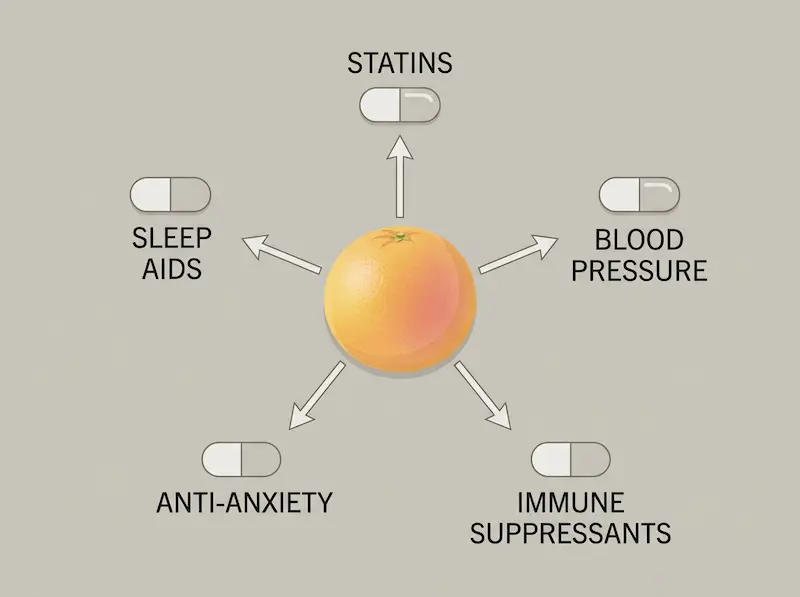
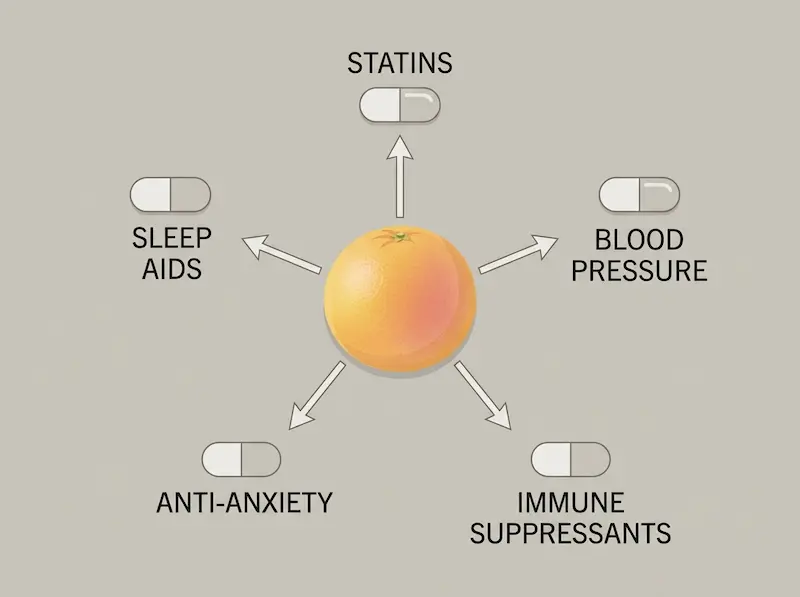
Grapefruit blocks the enzyme that breaks down many medications. The combinations are not rare, the warnings are quiet, and the consequences are slow enough that most people never connect the dots.
A woman came into my shop two winters ago carrying a small notebook. Her husband had been on a statin for six years. The previous month he had started getting muscle pain that would not go away, the kind that wakes you up at night. His doctor had not changed his prescription in years. Nothing else in his routine had changed either. Except one thing. They had bought a case of grapefruits during the holidays and had been juicing one every morning. She wanted to know if a fruit could really cause that much trouble. The honest answer is yes. And the story she was telling me is one of the most common ones I hear in this shop.
Grapefruit and medications is one of those topics that doctors mention once and pharmacists rarely repeat. Most patients hear the warning, nod, forget it by the time they leave the office, and never think about it again. Then years later something goes wrong and nobody traces it back to the breakfast table. This article covers every major category of medication affected by grapefruit, including the cousins of grapefruit that almost no one mentions, and what to actually do about it. A similar story I wrote about ginkgo and blood thinners follows the same pattern. People assume a fruit or a herb cannot affect a pill. The body does not care what we assume.
Why Grapefruit and Medications Don’t Mix Like Other Foods
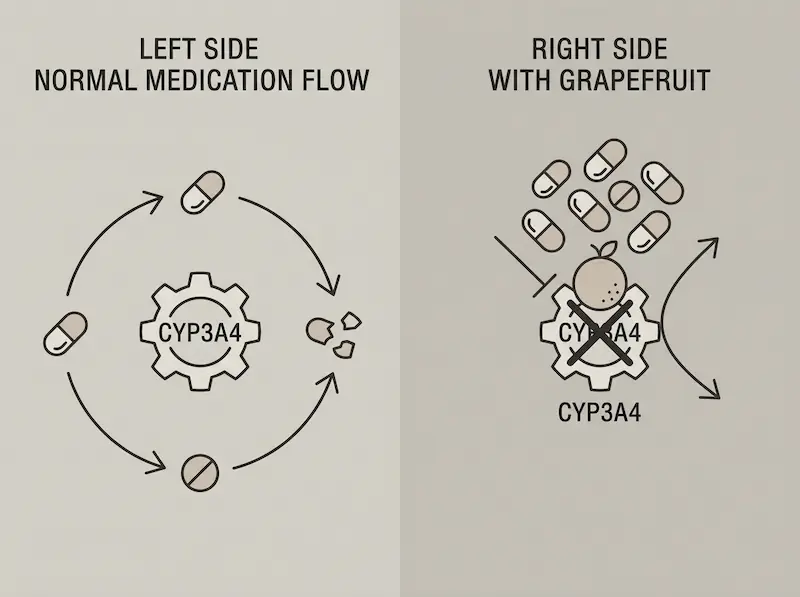
Most fruits do not interact with medications in any meaningful way. Grapefruit does because of a class of compounds called furanocoumarins. These compounds are not present in oranges, apples, bananas, or most other common fruits. They appear in grapefruit, in its close cousin the pomelo, in Seville oranges, and in trace amounts in limes. Once you eat or drink them, they go straight to your liver and small intestine and shut down an enzyme called CYP3A4.
CYP3A4 is the workhorse enzyme that breaks down somewhere between fifty and sixty percent of all prescription drugs. When it is working normally, it processes the medication, sends a portion of it into your bloodstream where it is supposed to be, and clears the rest. When grapefruit shuts it off, the medication accumulates. A normal dose can act like a double dose, sometimes more. And the effect is not short. A single glass of grapefruit juice can suppress this enzyme for twenty four to seventy two hours. Spacing the pill and the fruit a few hours apart does not solve the problem. Spacing them by a whole day might not be enough either.
The U.S. Food and Drug Administration has published an explicit warning about this for years. Their official guidance on grapefruit juice and medications is direct and worth reading. They confirm that even small amounts of grapefruit can cause meaningful changes in drug levels, and they list categories of medication where the risk is well documented.
The High-Risk Category: Statins
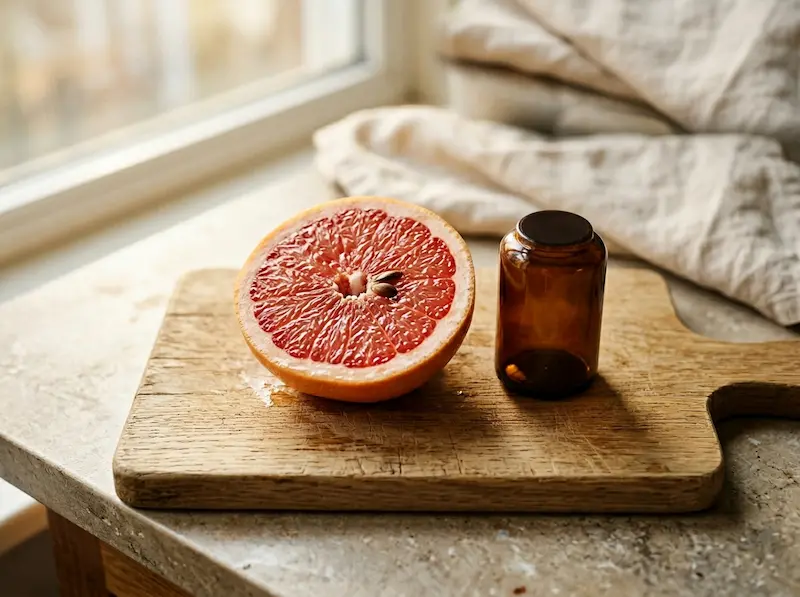
Statins are the most common medication in this list because they are one of the most prescribed drug classes in the world. Roughly forty million American adults take a statin daily. Most of them have never been told clearly which statins interact with grapefruit and which do not. The difference matters.
The high-risk statins are atorvastatin (Lipitor), simvastatin (Zocor), and lovastatin (Mevacor). These three are heavily metabolized by CYP3A4, the enzyme grapefruit blocks. Simvastatin and lovastatin are the worst of the group. Even a single glass of grapefruit juice can raise their blood levels two or three times higher than normal, which dramatically increases the risk of muscle pain, muscle breakdown, and in rare cases serious kidney damage. Atorvastatin is less affected but still meaningfully so.
The safer statins are pravastatin (Pravachol), rosuvastatin (Crestor), and fluvastatin (Lescol). These are processed by different enzymes that grapefruit does not affect. If you love grapefruit and you need a statin, this is a conversation worth having with your doctor. Switching from simvastatin to rosuvastatin is a small change for the prescriber and a meaningful change for breakfast. The broader picture of supplements and heart health is worth understanding alongside this, because nutrients work together with medications, not in isolation.
Blood Pressure Medications: The Mixed Picture
Blood pressure medications are not one category. They are at least five different drug families, and grapefruit affects them differently. The most affected group is the calcium channel blockers, particularly felodipine, nifedipine, and nicardipine. Amlodipine, which is one of the most prescribed blood pressure drugs in the country, is also affected but less dramatically. The interaction can cause blood pressure to drop too low, leading to dizziness, fainting, and a slow heart rate.
The safer blood pressure medications include ACE inhibitors like lisinopril and enalapril, ARBs like losartan and valsartan, beta blockers like metoprolol and carvedilol, and thiazide diuretics like hydrochlorothiazide. None of these are significantly affected by grapefruit. If you are on a calcium channel blocker and you love your morning grapefruit, ask your doctor whether one of the other families would work just as well for your situation. Magnesium also affects how blood pressure medication works in subtle ways through electrolyte balance, which is another layer most patients never hear about.
Other High-Risk Medications
The list does not stop at heart medications. Several other categories have documented serious interactions with grapefruit, and the warnings often appear in tiny print on the patient handout that most people throw away.
Immunosuppressants like cyclosporine and tacrolimus, used after organ transplant and for autoimmune conditions, can reach toxic levels with even modest grapefruit intake. The kidney damage risk in these cases is real and well documented. Certain antiarrhythmic drugs like amiodarone and dronedarone, used for irregular heart rhythms, also interact strongly. Some anti-anxiety and sleep medications, especially triazolam, midazolam, and buspirone, can accumulate to dangerous sedative levels. If you also struggle with middle-of-the-night waking and use any prescribed sleep aid, this is a category to take seriously. Some erectile dysfunction medications, certain antiretrovirals used for HIV, and some chemotherapy drugs round out the list.
This is not a complete catalog. There are over eighty five medications with documented grapefruit interactions, and roughly half of those can have serious consequences. The point is not to memorize them. The point is to ask the question every time a new prescription enters the picture.
The Hidden Cousins: Pomelo, Seville Orange, and Limes
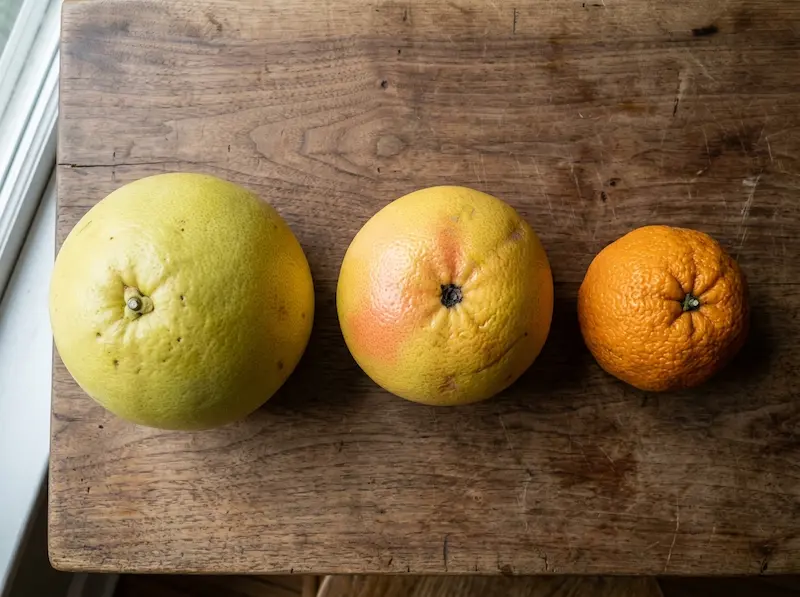
This is the part that catches almost everyone off guard. Avoiding grapefruit is one step. The harder step is knowing which other fruits contain the same furanocoumarins. The list is short but worth memorizing.
Pomelo is the largest citrus fruit, often the size of a small bowling ball, and it is the genetic ancestor of grapefruit. It contains nearly identical levels of furanocoumarins. Anyone of Korean, Chinese, or Southeast Asian background will recognize this fruit immediately, since it appears regularly during the holidays. The interaction risk is identical to grapefruit. Seville orange, the bitter orange used in traditional marmalade, also contains significant levels. That morning toast with marmalade is not as innocent as it looks if you are on any of the medications in this article. Tangelos, which are a grapefruit and tangerine hybrid, carry partial risk. Limes contain measurable amounts but generally not enough to cause major problems unless consumed in large quantities, such as in cocktails or as lime juice over multiple days.
Regular sweet oranges, lemons, mandarins, clementines, and tangerines are safe. They do not contain furanocoumarins in meaningful amounts. If you need a morning citrus and you are on a statin, a regular orange is the answer.
Timing and Quantity: How Much Is Too Much
This is where the common advice gets the answer wrong. Many patients are told they can eat grapefruit if they separate it from their medication by a few hours. That is not how the chemistry works. Furanocoumarins do not block the enzyme temporarily. They inactivate it. The body has to manufacture new enzyme molecules to recover, and that process takes anywhere from twenty four hours to three full days depending on the person.
Practical translation. If you take your statin in the evening and you had grapefruit juice with breakfast, the enzyme is still partially blocked when the pill arrives. If you ate grapefruit yesterday and took your pill today, the enzyme is still partially blocked. The only safe approach for medications with significant interactions is to avoid grapefruit and its cousins entirely. Not reduce. Not space out. Avoid.
The amount question matters too. Studies have shown that even one whole grapefruit or one eight ounce glass of juice is enough to cause meaningful enzyme suppression. Half a grapefruit is enough for some people. There is no safe sip for high-risk medications. The dose response curve is real but it starts low.
Practical Guide: What to Do Now
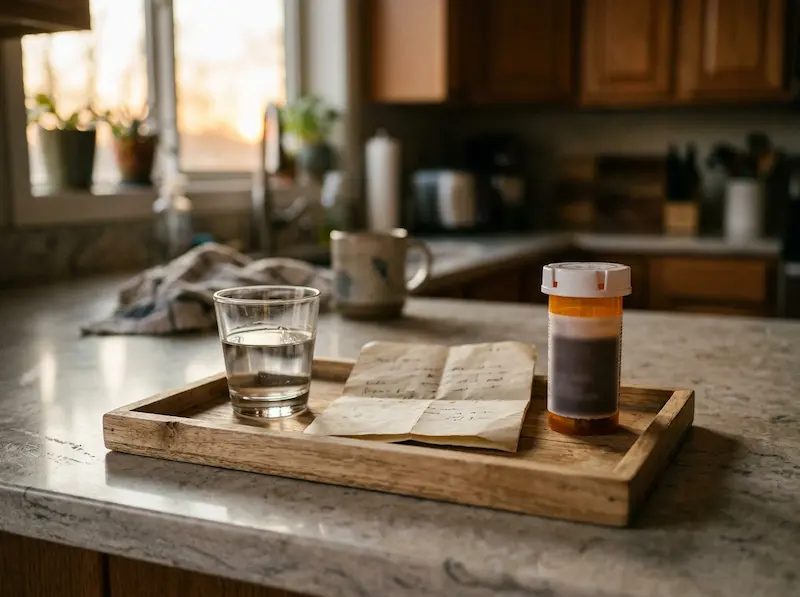
Here is the simple workflow I give to customers who walk in with a new prescription. It takes three minutes at the pharmacy counter and it costs nothing.
First, ask the pharmacist directly. Does this medication interact with grapefruit, pomelo, or Seville orange. Say all three names. Do not assume the pharmacist will volunteer the information, because most of them will only mention grapefruit if you ask. Second, ask whether the interaction is mild, moderate, or severe, and what the consequences would be. Third, if the interaction is moderate or severe, ask whether there is a comparable medication in the same class that does not have this issue. Fourth, write down the answer in the same notebook you keep your medication list in. Fifth, repeat this process every time a new prescription is added to your routine, because new combinations create new risks. Sixth, share the information with anyone who cooks for you, because the kitchen is where most of these mistakes happen.
If you are already on a medication and you have been eating grapefruit regularly, do not panic, but do bring it up at your next appointment. Most interactions are reversible. Stopping the grapefruit usually returns drug levels to normal within a few days. The longer you have been doing it, the more important the conversation, especially if you have noticed any new symptoms over the past few months. The broader picture of medication, lifestyle, and aging deserves attention every year, not just once at the original prescription.
The woman who came into my shop with the notebook went home, switched her husband to plain orange juice in the morning, and called his doctor about a possible statin change. Three weeks later she came back to tell me the muscle pain was gone. She still bought the magnesium I had recommended for sleep, and a fish oil that does not interact with anything, and she told me she felt like she had finally been let in on a secret that had been hiding in plain sight for six years. That is usually how this conversation ends. People are not careless. They have just never been given the full picture.
This article is based on personal experience selling supplements and on publicly available research from the U.S. Food and Drug Administration and peer-reviewed sources. It is not medical advice and not a substitute for evaluation by a qualified healthcare provider. Drug interactions with grapefruit can be serious and individual sensitivity varies. If you take any prescription medication, talk to your doctor or pharmacist before making changes to your diet, and do not stop or alter any prescribed medication on your own. If you experience muscle pain, dizziness, fainting, irregular heartbeat, or unusual fatigue while taking medications and consuming grapefruit, seek medical evaluation promptly.
3 thoughts on “Grapefruit and Medications: The Complete List of What Not to Mix”