If you keep waking up at 3AM every night, your body is trying to tell you something.
The hour is not random. The cause is usually one of four things — and most people are looking at the wrong one. Here is what 3am actually means, and what to do about it.
 |
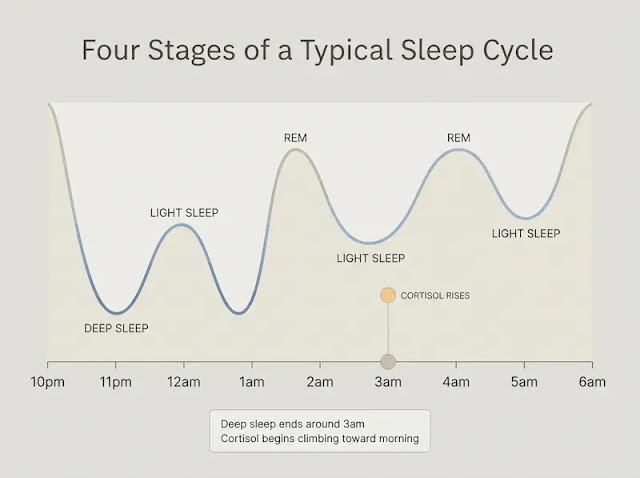
| Three in the morning is not random. It is the exact point where deep sleep ends and the body starts preparing to wake. |
I have been awake at three in the morning more times than I can count. Twenty years of professional baseball gives you early mornings whether you want them or not. Thirty years in a corporate job, with the dinners and the drinking that came with it, gave me a different kind of three a.m. — the kind where you wake up and your heart is already running, and you do not know why.
In my shop, this is one of the most common things customers ask about. Not insomnia. Not “I cannot fall asleep.” Something more specific. “I fall asleep fine. Then I wake at three. And I just lie there.”
The hour is so consistent that people start to wonder if there is something spiritual about it. There is not. The body is doing something measurable at that hour, and once you understand what, the four most common causes start to separate themselves. Most people are blaming the wrong one.
The 3AM Window — Why This Specific Hour
 |
| The ceiling looks the same to everyone at this hour. Tired, awake, and not quite sure why. |
A normal night of sleep is not one long block. It is four to five cycles of about ninety minutes each, moving between deep sleep, light sleep, and REM. The deep sleep — the kind that actually repairs the body — happens mostly in the first half of the night. By around three in the morning, for most adults, the deep sleep is essentially finished.
What replaces it in the second half of the night is more REM, more light sleep, and a gradual rise in cortisol. Cortisol is the hormone that prepares you to wake up. It is supposed to climb slowly between three and seven a.m., peaking around the time you get out of bed.
The problem is that for many people, cortisol does not climb gradually. It spikes. And a spike, in the middle of light sleep, is enough to pull you fully awake. You open your eyes, look at the clock, and it is somewhere between two-thirty and four. Almost always.
This is not insomnia in the medical sense. You fell asleep. You stayed asleep for several hours. The architecture of the night is just broken at the transition point. Fixing it means fixing what is happening to your cortisol, your blood sugar, your alcohol, or your hormones — in that rough order of likelihood.
Cortisol — The Most Common Cause
Of the customers who come into my shop with this complaint, I would guess seven out of ten are dealing with cortisol.
Chronic stress keeps cortisol elevated through the day. The body is supposed to wind it down in the evening so melatonin can rise and sleep can begin. In a person under sustained stress — money worries, work conflict, a sick parent, anything that does not resolve in a week — the cortisol does not wind down properly. It stays slightly high all night, and the natural three a.m. rise pushes it across the threshold of waking.
The clue is what you feel when you wake. If you are wide awake within seconds, mind already running through tomorrow’s problems or yesterday’s mistakes, that is cortisol. The body is in low-level alarm mode. Your heart may feel slightly fast. You are not anxious about anything specific — you are anxious about everything, in the vague way that 3am makes possible.
I have written before about how cortisol shapes more of the body than people realize — sleep, weight, mood, energy. The 3am wake-up is one of its earliest signals, often before the person even recognizes they are under chronic stress.
What helps cortisol-driven waking is rarely a sleep aid. It is what happens in the two hours before bed. Lower the lights. Stop checking the phone. Some people find magnesium glycinate genuinely useful here, especially the form I described in my earlier piece on magnesium — it has a quiet calming effect on the nervous system that other forms do not have. But the deeper fix is the stress itself, and that takes longer than a pill.
Blood Sugar — The Hidden One
This one most people never consider, and it is the second most common cause I see.
If you eat dinner early and eat lightly, your blood sugar drops through the night. In a healthy body, this is fine — the liver releases a small amount of glucose to keep things stable. But if the liver release is sluggish, or if you ate a lot of refined carbohydrates earlier in the evening, the blood sugar drops too far. The body responds by releasing adrenaline and cortisol to push the sugar back up. You wake up. Often hungry. Sometimes with a slight headache. Sometimes sweating.
The clue here is different from cortisol waking. Blood sugar waking often comes with a physical sensation — hunger, a slight shakiness, a desire to eat something. People who have had this for years sometimes keep a small snack by the bed without thinking about why.
The connection to insulin resistance and the kind of belly fat that quietly accumulates in midlife is real. Unstable blood sugar at night is often the same problem as unstable blood sugar during the day, just expressed in a different hour.
What helps blood sugar waking is, of all things, a small amount of slow-burning food before bed. A spoonful of nut butter. A few almonds. A small piece of cheese. Not a meal — just enough to keep the liver from having to wake you up to release glucose. It sounds wrong if you have been told never to eat before sleeping. For this specific pattern, it works.
Alcohol — The Quiet Trick
 |
| Alcohol helps you fall asleep faster. It also pulls you out of the deepest sleep before the night is finished. |
I drank for thirty years. Corporate dinners three nights a week, baseball locker rooms before that. So I am not going to lecture anyone. But there is one thing about alcohol and sleep that took me a long time to understand, and I think it is worth saying clearly.
Alcohol helps you fall asleep. That part is real. What it does not do is keep you asleep. As the body metabolizes the alcohol, somewhere between three and five hours after your last drink, there is a rebound effect. Cortisol spikes. Heart rate climbs slightly. The depth of sleep collapses.
If you had two glasses of wine with dinner at seven, the rebound hits around two to three a.m. If you had four drinks, it hits harder, and earlier. The timing is almost mathematical.
What makes this confusing is that you may not feel “drunk” at all. Two glasses of wine is not impairment. But it is enough to disrupt the architecture of the second half of the night. People who drink moderately and regularly often wake at the same hour for months without connecting it to the wine. I did not connect it until I stopped — and the 3am wake-ups stopped within a week. That experience is part of what I described in an earlier piece about thirty years of drinking.
If you wake at 3am and you had any alcohol in the evening, even a small amount, the alcohol is the first thing to test. Two weeks without it. If the waking stops, you have your answer.
Age, Hormones, and the Bladder
The fourth common cause is the simplest, and the one people resist the most.
The body changes with age. Deep sleep decreases. The bladder holds less. Hormone levels shift — for women in perimenopause and menopause, for men with slowly declining testosterone, for both sexes with subtle changes in thyroid and growth hormone. All of these can express themselves as 3am waking.
The clue for this category is that the waking is gentle, not anxious. You wake, you maybe go to the bathroom, and then you have trouble going back to sleep — not because your mind is racing, but because the depth of sleep just is not there anymore.
This category overlaps with the others. Hormonal changes raise cortisol sensitivity. Aging changes blood sugar stability. Alcohol hits harder. So a person in their fifties who wakes at 3am may be dealing with three causes at once, and addressing only one of them will not be enough.
What helps here is rarely dramatic. Earlier dinner. Less liquid in the two hours before bed. Cooler bedroom. Sometimes, in consultation with a doctor, hormone evaluation. The goal is not to sleep like a twenty-five-year-old. It is to wake at five-thirty rested, instead of waking at three exhausted.
What Actually Helps
 |
| Some nights you will lose. The point is not to fight the wake-up. It is to make the next night easier. |
If you wake at 3am every night, here is the order I would suggest testing.
For two weeks, cut out evening alcohol completely. Not reduce. Cut. If the waking stops or improves significantly, you have your answer, and you can decide what to do with that information.
If alcohol was not the cause, look at the last two hours before bed. Are you scrolling on a bright phone screen until you turn off the light? Are you handling work email at ten p.m.? Are you arguing with someone in your head about something that happened that day? These are cortisol problems, and they need behavioral change more than they need a supplement.
If the wake-up comes with hunger or shakiness, try a small protein-and-fat snack about an hour before bed. A spoonful of almond butter. A few walnuts. Nothing sweet. Give it a week.
If none of that helps, and the waking is more than two weeks running, see a doctor. There are conditions that present exactly this way — sleep apnea is a common one, especially in men who snore — and they will not improve with lifestyle changes alone.
One thing I would not do is panic about it. The body has waking 3am as a built-in feature for evolutionary reasons. Our ancestors did not sleep in one block — they slept, woke for an hour or two, and slept again. The modern expectation of eight unbroken hours is historically unusual. Some occasional 3am waking is normal. Every night, for months, with exhaustion the next day — that is the signal something needs attention.
Look at the alcohol first. Then the stress. Then the food. Then the body. Most of the time, the answer is in there, and it is something you can change.
This article reflects my personal experience as a former athlete, retired executive, and current supplement shopkeeper. It is not medical advice. If you wake at 3am every night for more than two weeks, or if waking comes with chest pain, shortness of breath, panic, or persistent low mood, talk to a doctor. Persistent middle-of-the-night waking can be a signal of sleep apnea, anxiety, depression, thyroid issues, or other conditions that deserve proper evaluation.