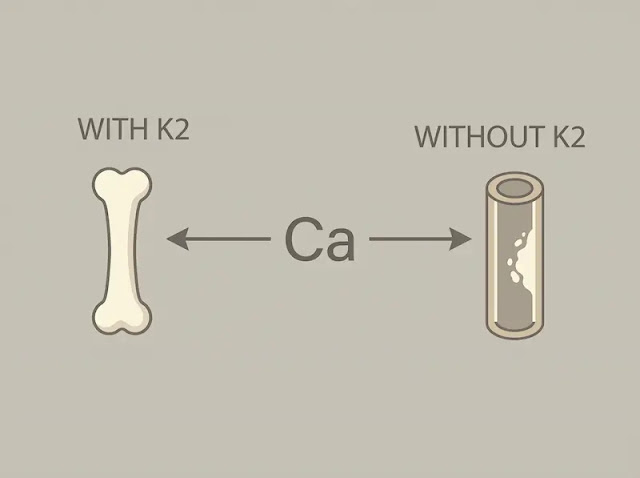
Most people take vitamin D3 without K2—and that small mistake can matter more than you think.
Vitamin D pulls calcium into the blood. Without K2, the body has no map for where to send it. Bones lose. Arteries gain. Here is what that actually means.
 |
| Vitamin D pulls calcium into the blood. K2 decides where it goes next. Bones or arteries. The choice is not yours. |
A customer came into my shop last spring holding a bottle of vitamin D3 5,000 IU. He had been taking it for three years. His doctor had just told him his coronary calcium score was high. He asked me if the two things were connected.
The honest answer is — maybe. Not in the way most people imagine, but enough to matter. I have been selling supplements long enough to see this pattern more than once. Someone reads about vitamin D deficiency, starts a high dose, takes it for years, and never hears the word K2 even one time. I wrote about my own fracture and vitamin D deficiency in detail elsewhere. This article is about the part that piece did not cover deeply enough.
What Vitamin D Actually Does With Calcium
Vitamin D has one main job in the calcium story. It helps the gut absorb calcium from food. Without enough D, you can drink a gallon of milk and still pull only a small fraction of the calcium into your blood. With enough D, absorption can jump two or three times.
That sounds like a good thing. And mostly it is. The problem starts after the calcium reaches the blood. Vitamin D does not tell the calcium where to go. It just opens the door. Once calcium is circulating, the body needs a separate signal to send it to the bones where it belongs, instead of leaving it floating in the bloodstream or letting it settle into soft tissue.
That separate signal is vitamin K2. Not K1, which handles blood clotting. K2 — specifically the MK-7 form — activates two proteins called osteocalcin and matrix Gla protein. Osteocalcin tells calcium to enter bone. Matrix Gla protein tells calcium to stay out of arteries. Both proteins are useless without K2 to switch them on. Hormones, sleep, and stress all play a role in how the body manages minerals, but K2 is the specific traffic director for calcium.
 |
| One pill, one nutrient, one direction. That is the part most people get wrong without knowing it. |
Where the Calcium Goes Without K2
If you take vitamin D3 without K2, especially at high doses for years, the calcium your gut now absorbs more efficiently has to go somewhere. Some of it reaches bone. Some of it does not. The “does not” part is the problem.
Studies on arterial calcification have shown an association between low K2 intake and higher rates of calcium deposits in the coronary arteries. The Rotterdam Study, which followed over four thousand adults for several years, found that people in the highest K2 intake group had significantly lower rates of arterial calcification and cardiovascular death compared to the lowest group. K1 intake showed no such effect.
This is not a guarantee that taking D3 alone gives you heart disease. The body has other defenses. But if you are someone who already has risk factors — high blood pressure, family history, years of drinking, smoking, sedentary work — adding high-dose D3 without K2 is not the move I would make. Alcohol quietly drains both vitamin D and K2 stores faster than most people realize, which makes the imbalance worse for anyone with a long drinking history.
The MK-4 vs MK-7 Question
K2 comes in two main forms you will see on supplement labels. MK-4 and MK-7. They are not the same thing, and the difference matters.
MK-4 has a very short half-life in the body. A few hours. To get any meaningful effect from MK-4, you need to dose it multiple times a day at higher amounts, usually 15 mg or more. That is why almost no consumer supplement uses MK-4 properly. The doses on most bottles are far too low to do anything.
MK-7 has a half-life of around three days. One dose, once a day, and the level in your blood stays stable. Almost every credible K2 supplement on the market today uses MK-7, usually derived from natto fermentation. If the bottle does not specify the form, assume the product is not serious about results. Read the label.
 |
| Natto leads by a wide margin. Aged cheese and egg yolks help. Most Western diets give you almost none of it. |
How Much K2 You Actually Need
The numbers floating around the internet are messy. Some sources say 45 mcg. Some say 180 mcg. Some say 360 mcg. The honest range, based on the studies that actually showed bone and arterial benefit, is 100 to 200 mcg of MK-7 per day for most adults. That is what I take. That is what I recommend when customers ask.
Pairing matters too. K2 is fat-soluble, like D3. Take them with a meal that contains some fat — eggs, avocado, olive oil, fatty fish. Empty stomach gives you a fraction of the absorption. And do not forget the third leg of this stool. Magnesium is the cofactor most people forget — without enough magnesium, vitamin D cannot be converted into its active form in the first place. D3, K2, and magnesium work as a team. Skip one and the other two cannot finish the job.
Foods That Contain K2
Natto is the heavyweight. One small serving of natto, maybe 40 grams, can give you over 400 mcg of K2 MK-7. Nothing else in the natural food supply comes close. The Japanese have eaten it for centuries, which is one of the leading theories for why traditional Japanese populations have such low rates of hip fracture and arterial calcification despite low calcium intake.
If natto is not your thing — and most people who try it once understand why — the next best options are aged hard cheeses like Gouda and Edam, egg yolks from pasture-raised hens, and dark chicken meat. Goose liver if you can find it. None of these come close to natto, but a regular pattern of all of them can cover a meaningful portion of your daily K2 need without supplements.
Sauerkraut and other fermented vegetables contain some K2, but the amount varies wildly by batch and brand. Do not count on them as a primary source.
Practical Guide — Two Bottles, One Routine
 |
| Two bottles instead of one. Same time of day, same meal, same simple rule. That is the whole change. |
Here is what works for most people. D3 2,000 to 4,000 IU per day, paired with K2 MK-7 100 to 200 mcg per day. Both taken with the largest meal of the day, ideally one that has some fat in it. Some brands now sell them combined in a single capsule, which is fine and slightly cheaper. Just check the label and make sure the K2 form is MK-7, not MK-4.
Timing inside the day matters a little. Some people find vitamin D taken late in the evening interferes with their sleep, possibly through its effect on melatonin pathways. If you are already someone who wakes at odd hours, some people find evening doses disrupt sleep in ways they did not expect. Morning or midday is the safer default.
One serious warning. If you are on warfarin or another vitamin K antagonist for blood thinning, do not start K2 on your own. Talk to your doctor first. K2 can interfere with how warfarin works, and the adjustment has to be made carefully. Newer blood thinners like apixaban or rivaroxaban do not have this issue, but warfarin does. Be honest with your doctor about every supplement you take.
That is the whole picture. D3 opens the door. K2 directs the traffic. Magnesium keeps the system running. One without the others is half a strategy, and over the years, half a strategy adds up to a real problem.
This article is based on personal experience and publicly available research. It is not medical advice. If you have heart disease, kidney disease, are on blood thinners, or have any condition affecting calcium or vitamin metabolism, talk to your doctor before starting D3 or K2 supplements. Dosage and form may need to be adjusted for your individual case.