If you’ve ever connected iron supplements and constipation, you’re not imagining it—there’s a real reason.
Most people quit iron pills within two weeks because of the same problem. Here is why iron blocks the bowels, how long it really lasts, and what quietly fixes it.
 |
| Iron is one of the hardest minerals for the body to absorb. The part that does not absorb has to go somewhere. |
There is a woman who comes to my shop maybe once a month. Her doctor put her on iron about a year ago. Low ferritin, tired all the time, the usual story. She bought a bottle, took it for ten days, and stopped.
When I asked why she stopped, she did not say “side effect.” She said, almost apologetically, “I could not go to the bathroom. For five days. I was afraid.”
This is the conversation I have more often than any other about iron. Not about energy, not about ferritin numbers. About the bathroom. People quit the supplement they actually need, and then a year later they are still tired, still anemic, and they tell their doctor “iron does not work for me.”
Iron works. The problem is almost always the form, or the timing, or what you swallow it with. Once you understand why constipation happens, the fix is not complicated.
Why Iron Causes Constipation
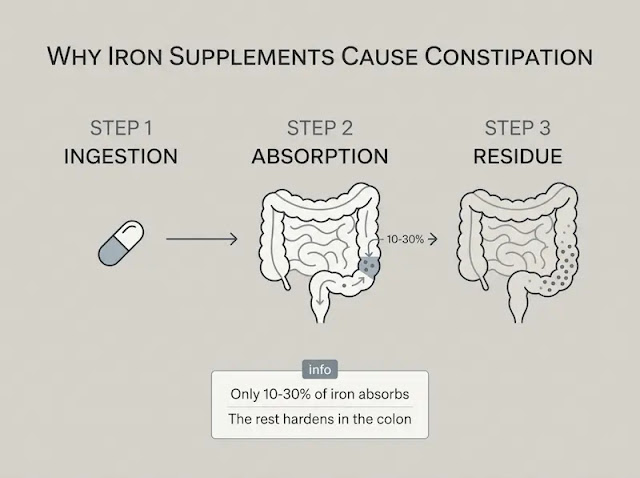
Iron is one of the hardest minerals for the human body to absorb. Even under ideal conditions, only about ten to thirty percent of the iron you swallow actually enters the bloodstream. The rest stays in the digestive tract.
That unabsorbed iron does two things. First, it changes the color of the stool — that dark, almost black color that scares people the first time they see it. This is harmless. It is just iron that did not get absorbed, passing through.
The second thing is the problem. Unabsorbed iron interacts with the gut. It binds to other compounds, it slows down the natural movement of the intestine, and it pulls less water than minerals like magnesium do. The result is harder, slower, darker stool. In some people, this happens within two or three days of starting. In others, it builds up over a week.
Doctors call this “iron-induced constipation.” In Korea we just say 철분제 먹고 배가 막혔다 — “the iron pill blocked the belly.” Same thing.
What makes it worse is that most people are told “take iron on an empty stomach for better absorption.” That advice is technically correct for absorption, but it is the worst possible advice for tolerability. On an empty stomach, the iron concentrates and irritates the gut lining. Nausea goes up. Constipation gets stronger. Many people quit before the iron has any chance to help.
How Long Does It Last
This is what most people actually want to know, and the honest answer has two parts.
While you are still taking the iron, the constipation usually starts within three to seven days and stays as long as you keep taking the pills. It does not “go away on its own” if you continue. The body does not adapt to it the way it adapts to caffeine or alcohol. As long as unabsorbed iron is reaching the colon, the problem stays.
When you stop taking iron, the bowels usually return to normal within two to four days. Some people feel relief in 48 hours. Some take a full week, especially if they were on iron for more than a month and the colon needs time to clear.
Here is the part doctors do not always explain. If you have been taking iron for several weeks and you stop because of constipation, your ferritin level will start dropping again within a few months. You are back where you started. The fatigue comes back, the pale skin comes back, the doctor prescribes iron again, and the cycle repeats.
The way out of the cycle is not “stop taking iron.” It is “take a different iron, with different timing, with the right food.”
The Form Matters (Again)
 |
| Same mineral on every label. The word in front of “iron” is what decides whether you spend the next week in the bathroom or not. |
If you read my earlier piece on magnesium forms, you already know the principle. The word in front of the mineral name is what decides almost everything.
For iron, three forms cover ninety percent of what you will see on a store shelf.
Ferrous sulfate is the cheapest and the one most doctors prescribe by default. It is also the worst for tolerability. High dose, harsh on the stomach, strong constipation in most people. If you have ever taken a prescription iron pill and felt miserable, this is almost certainly what you took.
“Ferrous gluconate” is gentler than sulfate but absorbs less iron per pill. You need a higher dose to get the same effect. For some people this is a reasonable trade.
Ferrous bisglycinate is iron bound to the amino acid glycine. It absorbs much more efficiently — sometimes two to three times better than sulfate — which means a smaller amount of unabsorbed iron reaches the colon. Less unabsorbed iron means less constipation. In my shop, this is the form I hand to almost anyone asking about iron tolerance.
There is also heme iron, which comes from animal sources and is the form your body absorbs most easily of all. It costs more, but the tolerability is excellent. If you are not vegetarian and the price does not bother you, heme iron causes the least bathroom trouble of any form I have ever stocked.
One quiet warning. Many drugstore “iron” bottles do not clearly state the form on the front. You have to turn the bottle around and read the small print. If the back says only “iron 65 mg,” with no form specified, assume it is sulfate. That is the cheap default.
What to Take It With
 |
| A small piece of fruit changes the math. Vitamin C can triple how much iron actually enters the bloodstream. |
Vitamin C changes the math more than any other single thing.
When iron and vitamin C are in the stomach at the same time, vitamin C converts iron into a form the body absorbs much more easily. Some studies show absorption doubles or triples with 100 milligrams of vitamin C alongside the iron pill.
This matters for constipation in a way most people miss. Better absorption means less iron left over in the colon. Less leftover means less constipation. The same pill, taken with a small glass of orange juice or half a kiwi, often causes noticeably less trouble than the same pill taken with water.
I tell customers a simple thing. Buy the iron and buy a small bag of mandarin oranges. Eat one when you take the pill. That is it. No fancy vitamin C supplement needed, though one works too if fruit is not convenient.
What about food in general? The old advice was “empty stomach for absorption.” The new and more honest advice is: with a small amount of food, ideally something containing vitamin C, away from the foods listed in the next section. Yes, you sacrifice a small amount of absorption by eating. You gain back much more by not quitting the pill in week two.
What Blocks Iron
 |
| Coffee, tea, calcium, whole grains. Four common things that quietly cut your iron pill in half before it even reaches your blood. |
This is the part almost no one explains, and it is the reason many people take iron for months and see no improvement in their ferritin.
Coffee and tea. Both contain compounds called polyphenols that bind to iron in the gut and prevent absorption. A single cup of black tea taken with an iron pill can reduce absorption by more than sixty percent. Coffee is almost as bad. Keep at least one hour between your iron and any caffeine.
Calcium. Calcium and iron compete for the same absorption pathway. A glass of milk, a calcium supplement, a yogurt — any of these taken with iron cuts the absorbed amount significantly. Keep them at least two hours apart.
Whole grain bread and high-fiber cereal. These contain phytates, which bind iron and reduce absorption. This is one reason vegetarians often struggle with iron. The diet that is otherwise healthy quietly works against the supplement.
Acid-blocking drugs. Omeprazole, esomeprazole, and similar proton pump inhibitors reduce stomach acid, and stomach acid is required to convert iron into its absorbable form. People on long-term PPIs often have low iron without knowing why. If you are on one of these drugs, the form of iron matters even more — bisglycinate or heme is much better than sulfate in low-acid conditions.
Eggs. This one surprises people. Eggs contain a protein that binds iron. A breakfast of toast and eggs with your iron pill is almost the worst possible combination — phytates, calcium if there is butter or cheese, and the egg protein all working together to block what you swallowed.
The simple rule I give customers: take iron in the late morning or early afternoon, with a piece of fruit, away from coffee, tea, dairy, and bread. Not pretty, but it works.
A Practical Guide
If iron made you constipated and you stopped, here is what I would suggest before giving up on the supplement entirely.
Switch from ferrous sulfate to ferrous bisglycinate. Lower dose, gentler stomach, less leftover in the colon. Take it once a day, in the late morning, with a mandarin orange or a small glass of orange juice. Wait at least an hour after your morning coffee. Wait at least two hours after any dairy.
Drink more water than you think you need — iron supplementation works much better with good hydration. Walk a little each day. Both of these help the bowels move on their own and reduce the constipation independently.
Give it three weeks. By the end of the first week, the constipation should be milder than what you remembered. By the third week, your energy should start to lift, even before your ferritin number changes on a blood test. Energy improvements often come together with better sleep and lower stress, and iron sits quietly inside that picture.
If after three weeks of the better form, the right timing, and proper food pairing you are still struggling with hard stool, then it is worth talking to your doctor about heme iron, or about a different dosing schedule — every other day instead of daily, which some recent research suggests may actually absorb just as well with far fewer side effects.
What I would not do is quit. Low iron does not stay quiet. The fatigue comes back, the pale skin comes back, sometimes the brain fog comes with it. The pill is rarely the real problem. The label on the pill, the cup of coffee next to the pill, the empty stomach the doctor recommended — those are the problems.
Read the back of the bottle. Move the orange to the same table. Move the coffee to a different hour. That is most of the work.
This article reflects my personal experience as a supplement shopkeeper and is not medical advice. Talk to your doctor before starting or changing an iron supplement, especially if you have a condition such as hemochromatosis where iron supplementation can be harmful.