Four forms on the shelf. Only three reach the brain. The fourth fills the bottle and does almost nothing for anxiety. Here is how to tell them apart.
 |
| Same mineral on every label. Only three of the four actually reach the brain. The fourth is just filling up your bottle. |
A woman walked into my shop a few months ago looking tired. She said she had been waking up at 4 in the morning with her heart racing for almost a year. Her doctor had told her it was anxiety. She did not want to start medication yet. She had read online that magnesium helps. She picked up a large bottle of magnesium oxide because it was the cheapest, and she asked me if it would work.
I told her honestly — probably not. Not the way she was hoping. The form on the label decides almost everything, and oxide is the one form that does the least for anxiety. She looked at me like I had just told her the sky was green. So I walked her through the same explanation I am going to walk you through now.
Before going further, one thing has to be clear. Magnesium is not a cure for anxiety. Anyone selling it that way is overstating what the research actually shows. What magnesium can do is lower the volume on a nervous system that has been turned up too high for too long. For some people that is a real difference. For others it is not enough on its own. I wrote about citrate and glycinate from a different angle elsewhere — that piece was about side effects. This one is about the brain.
Why Magnesium Affects Anxiety in the First Place
The nervous system runs on a balance between two signals. One signal turns things on. That is glutamate, working through a receptor called NMDA. The other signal turns things down. That is GABA. When the balance tips toward too much on and not enough off, you get the symptoms most people call anxiety. Racing thoughts. Tight chest. Trouble falling asleep. Waking at strange hours.
Magnesium sits right at this intersection. It blocks NMDA receptors gently, lowering the on signal. It also supports GABA activity, raising the off signal. Both effects, modest on their own, add up to a calmer baseline over weeks of consistent intake. The research is not flashy. Studies show a small to moderate improvement in self-reported anxiety scores, not transformation. But for people whose levels are genuinely low, the change can be noticeable.
The catch is that cortisol and the stress system play the bigger role here than people want to admit. If you are running on three hours of sleep and finishing your day with two drinks, no supplement is going to fix that. Magnesium helps the underlying machinery. It does not replace the basic repairs.
 |
| Magnesium does not erase anxiety. It lowers the volume on the stress signals that make a hard day feel impossible. |
The Forms That Actually Help
Three forms have enough evidence behind them to be worth your money for anxiety. Each has a slightly different angle.
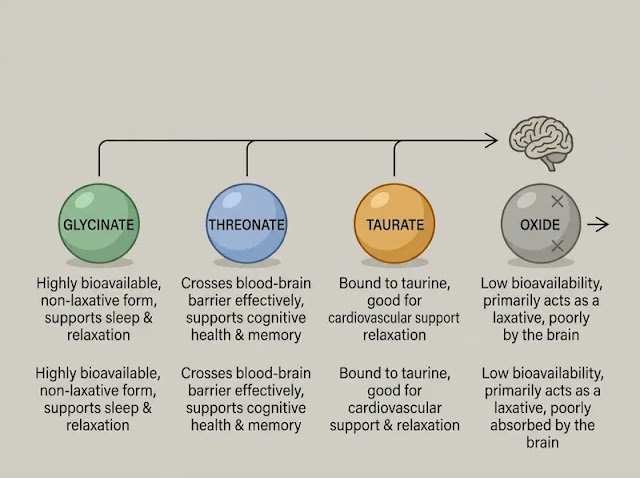
Glycinate. Magnesium bound to the amino acid glycine. Glycine itself is calming. It activates GABA receptors and lowers excitatory signaling. So you are getting magnesium plus a small dose of a calming amino acid in the same capsule. This is the default I recommend for most people asking about anxiety. It is gentle on the gut, absorbs well, and works best taken in the evening.
Threonate. A newer form bound to L-threonic acid. The selling point is that it crosses the blood-brain barrier more efficiently than other forms. The studies on this are mostly animal and small human trials, but the mechanism is real. People who describe their anxiety as racing thoughts, mental loops, or trouble shutting the brain off at night tend to respond to threonate better than to glycinate. It is more expensive. Worth trying if glycinate alone is not enough.
Taurate. Magnesium bound to taurine. Taurine has its own effect on the heart and vascular system, calming the rate and stabilizing rhythm. For the version of anxiety that shows up first as a pounding heart or chest tightness — the panic-style symptoms — taurate often does what glycinate cannot. Less popular, harder to find, but useful for the right person.
The Form That Does Nothing for Anxiety
Magnesium oxide. The cheapest form. The one in most large warehouse-store bottles. Absorption is around four percent in most studies. Ninety-six percent of what you swallow passes through and out. What little does absorb does not reach the brain in meaningful amounts.
Oxide has one legitimate use — short-term relief of constipation, because the unabsorbed portion pulls water into the gut. That is also why people who take it for anxiety often report digestive trouble first. If your goal is anxiety, oxide is not the move. Read the back of the bottle. The first word in front of “magnesium” decides almost everything.
 |
| Glycinate for general calm. Threonate for racing thoughts. Taurate for the heart-pounding kind. Three different jobs, three different forms. |
How Long It Takes to Notice a Difference
This is where most people quit too early. Magnesium does not work like a sleeping pill. It does not work like an anxiety medication. It works by slowly raising the level of magnesium inside your cells, and cellular magnesium turns over over weeks, not hours.
A realistic timeline. The first week, you may notice nothing. The second week, sleep often shifts first — falling asleep a little faster, fewer wake-ups in the night. By week three or four, the daytime difference shows up. A slightly longer fuse. Less reactive to small annoyances. Fewer of those tight-chest moments during the day. Some people notice the change first in their sleep before they notice it anywhere else.
If you have taken a good form at a real dose — 300 to 400 mg of glycinate, threonate, or taurate — every night for six weeks and felt nothing, then magnesium is probably not your missing piece. That is honest, not pessimistic.
What to Take It With and When
Timing matters more than most people think. Magnesium for anxiety is an evening supplement. Take it 30 to 60 minutes before bed, with a small snack if your stomach is sensitive. Vitamin B6 in the same dose helps — B6 is a cofactor for several of the same neurotransmitter pathways magnesium supports.
What to avoid. Caffeine after 2 pm if you can manage it. Coffee blocks the calming effect by the time the magnesium would be working. Calcium supplements at the same time — they compete for absorption. And alcohol. Alcohol quietly drains magnesium faster than most people realize, which is one reason heavy drinkers often develop both magnesium deficiency and anxiety at the same time. The drink calms the symptoms for two hours and worsens the underlying problem for the next two days.
When Magnesium Is Not the Answer
Here is the honest part most blogs leave out. Some anxiety is not a magnesium problem. Generalized anxiety disorder, panic disorder, post-traumatic stress, and major depression with anxious features are clinical conditions that need clinical care. Magnesium might play a small supportive role for someone already in proper treatment, but it is not a replacement for it.
If your anxiety includes panic attacks that come out of nowhere, persistent dread that does not lift, intrusive thoughts you cannot control, avoidance of normal activities, or any thoughts of self-harm — talk to a doctor or a licensed mental health professional. That is not a failure on your part. That is the right tool for the right problem. The broader nutrient picture also matters — the bigger nutrient picture matters more than any single pill, but no nutrient strategy substitutes for proper care when the situation calls for it.
 |
| Evening, away from coffee, with a small meal. Boring rules. The kind that quietly change how the next morning feels. |
For the woman in my shop, I swapped the oxide for glycinate. Three hundred milligrams in the evening. Eight weeks later she came back. She still woke at 4 in the morning sometimes, but the racing heart was gone. She had also stopped her evening wine. I do not know which change did more. She did not know either. That is usually how it goes.
This article is based on personal experience selling supplements and on publicly available research. It is not medical advice and not a substitute for evaluation by a qualified healthcare provider. If you are experiencing significant anxiety, panic, persistent low mood, or any thoughts of self-harm, please talk to a doctor or mental health professional. If you are already on medication for anxiety, depression, or any other condition, talk to your prescriber before starting magnesium — interactions and dose adjustments may apply.