Statins and grapefruit are one of the most dangerous combinations in modern medicine. The warning is printed on the bottle. Almost nobody reads it. The people who do, often misunderstand how long they actually need to wait.
A customer came into my shop last spring. Sixty-one years old, retired teacher, on atorvastatin for about three years. He had been waking up with calf pain so severe he could not get out of bed without holding the wall. He had assumed it was age. He had assumed it was the statin itself. He had not assumed it was the half grapefruit he ate with breakfast every morning for the past six months because his wife read it was good for blood pressure.
He stopped the grapefruit. The calf pain was gone in eleven days. He never changed the statin dose. I have seen this pattern more times than I can count, and it is the reason I wrote the complete guide to grapefruit and medications earlier this month. This article is the deeper version of one specific chapter from that guide.
Why Statins and Grapefruit Are the Most Dangerous Combination
Most drug-food interactions involve one mechanism. Statins and grapefruit involve two, which is why this combination is more dangerous than almost any other on the pharmacy shelf.
The first mechanism is CYP3A4, an enzyme in the small intestine and liver that breaks down many medications before they enter the bloodstream. Grapefruit contains compounds called furanocoumarins that shut this enzyme down. When the enzyme is blocked, the medication is not broken down at the normal rate. It accumulates. A single dose of atorvastatin taken with grapefruit can deliver the blood concentration of three or four normal doses.This is why statins and grapefruit are treated as a special case in pharmacology textbooks.
The second mechanism is OATP1B1, a transporter protein that helps move statins into liver cells where they do their work. Grapefruit interferes with this one too. The result is more statin staying in the bloodstream and reaching the muscles instead of the liver.
This is why the muscle pain pattern shows up. The statin is not behaving like the dose printed on the bottle. It is behaving like a dose three to five times higher.
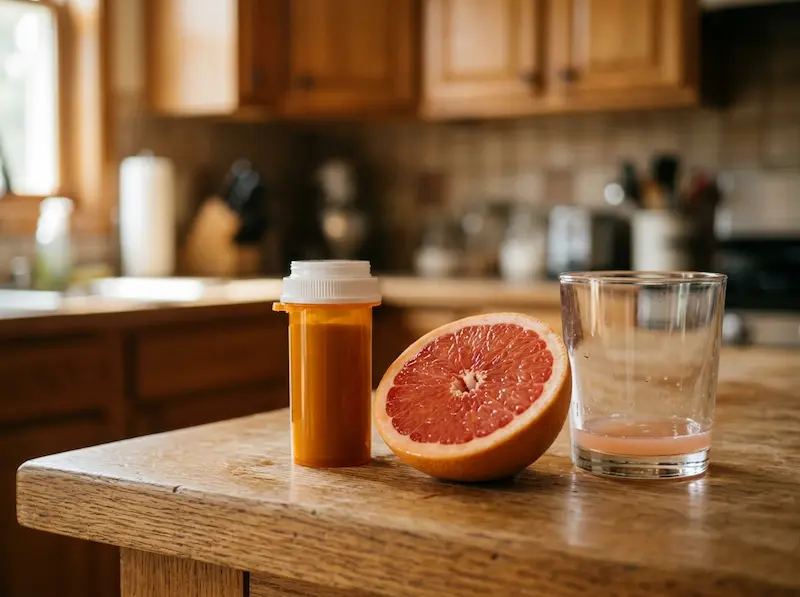
Which Statins Are Risky and Which Are Safer
Not every statin reacts to grapefruit the same way. This is the single most useful piece of information in this article, and most people on cholesterol medication have never heard it from their doctor.
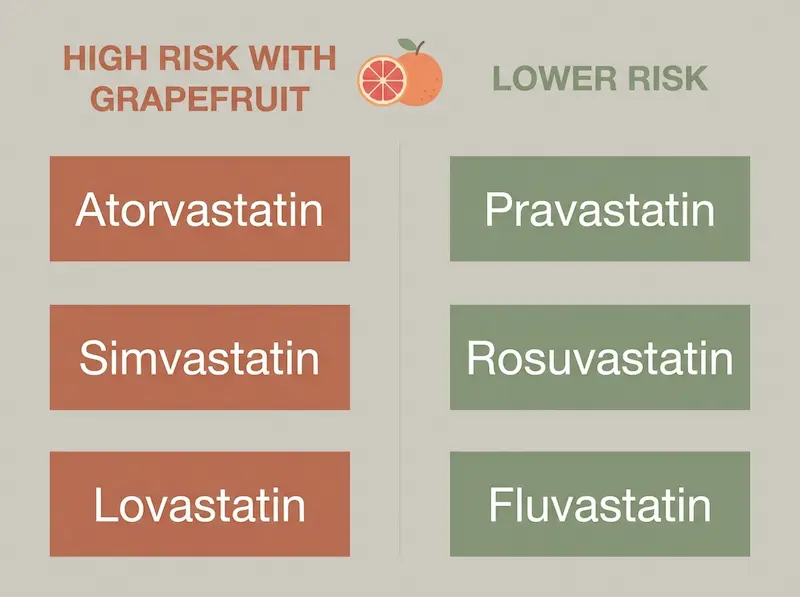
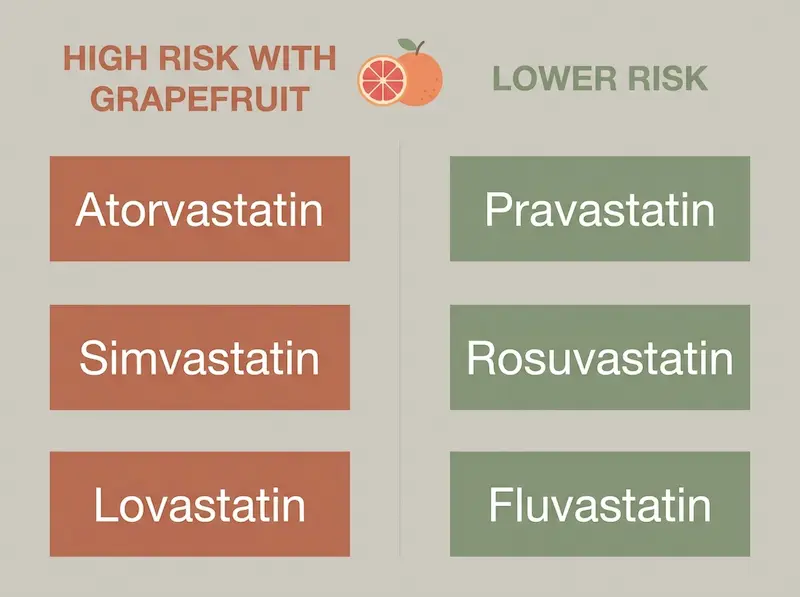
The high-risk statins are the ones broken down by CYP3A4. These include atorvastatin (Lipitor), simvastatin (Zocor), and lovastatin (Mevacor). Simvastatin is the most dangerous of the three. Studies have shown blood concentrations rising by 260 percent when taken with grapefruit juice, which is roughly the same as taking three and a half doses at once.
The lower-risk statins use different metabolic pathways. These include pravastatin (Pravachol), rosuvastatin (Crestor), and fluvastatin (Lescol). They are not completely free of any grapefruit effect, but the interaction is small enough that most cardiologists consider them safe with moderate grapefruit intake.
If you are currently taking a high-risk statin and you cannot give up grapefruit, this is a conversation worth having with your doctor. Switching from atorvastatin to rosuvastatin is a common and clinically straightforward change. According to Mayo Clinic guidance on grapefruit and statins, this is one of the most common medication adjustments made for patients who want to keep grapefruit in their diet.
The 72-Hour Question Most Doctors Skip
Here is where most patients get the wrong answer, often from the people they trust most.
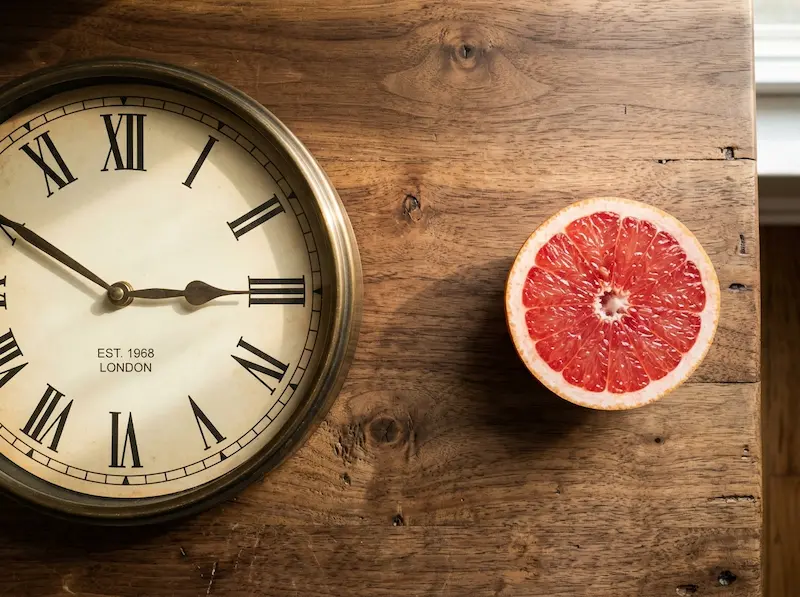
The common advice is to separate grapefruit and statins by four hours, sometimes twelve. I have heard pharmacists say this. I have heard doctors say this. It is not correct. The reason it is not correct is that grapefruit does not just compete with the medication in your stomach. It permanently disables the CYP3A4 enzyme molecules it touches. Your body has to manufacture new enzyme to recover.
That manufacturing process takes time. Research has shown the enzyme begins recovering within twenty-four hours, but full recovery takes up to seventy-two hours. This means a single glass of grapefruit juice on Monday morning can still be affecting your Wednesday evening statin dose.
The practical conclusion is simple. If you are on a high-risk statin, there is no safe daily window for grapefruit. The four-hour rule and the twelve-hour rule are both myths. The only safe approach is to remove grapefruit from your diet entirely, or to switch to a lower-risk statin.
This is the part doctors often skip because it sounds extreme. It is not extreme. It is just how the enzyme actually works.For anyone serious about avoiding muscle pain, statins and grapefruit simply do not belong in the same week.
What Happens If You Already Mixed Them
If you have been taking a high-risk statin and eating grapefruit regularly, do not panic. Most people in this situation never develop a serious problem. But you should know the warning signs.The combination of statins and grapefruit does not affect everyone the same way.
The most common early symptom is muscle pain or weakness, particularly in the larger muscles of the thighs, calves, shoulders, and lower back. It often appears as a deep ache rather than a sharp pain. Some people describe it as feeling like they overexercised when they did not. The magnesium I write about in my article on magnesium and muscle tension will not fix this kind of pain, because the cause is pharmacological rather than mineral.
The dangerous version of this is called rhabdomyolysis. It is rare but serious. The warning signs are severe muscle pain combined with dark, tea-colored urine, unusual fatigue, or fever. If you experience these together, this is not a wait-and-see situation. Go to the emergency room.
For the more common mild muscle aches, the first step is to stop the grapefruit and see what happens in two to three weeks. Most people, like the customer I described at the start, see significant improvement within ten to fourteen days.
What to Take With Your Statin Instead
The good news is that most fruit is completely safe with statins. Regular oranges, apples, pears, grapes, berries, bananas, and melons have no meaningful interaction. The grapefruit problem is specific to the furanocoumarin family of compounds, and most common fruits do not contain them.

The fruits to be careful with are the close relatives of grapefruit. Pomelo contains the same compounds and is often eaten in Asian households without anyone connecting it to grapefruit. Seville oranges, used in traditional marmalade, contain the compounds too. Limes have a smaller but measurable effect. Regular sweet oranges and tangerines do not.
For people taking statins specifically for cardiovascular reasons, the broader picture also matters. Sleep, stress, alcohol intake, and underlying hormone balance all influence cholesterol numbers more than most people realize, which is something I explored in the Wegovy series for middle-aged men. A statin is a tool, not the whole strategy.
Questions Worth Asking Your Pharmacist
The next time you pick up your statin prescription, three minutes at the counter can save you months of unexplained muscle pain. These are the questions I wish every customer would ask before leaving the pharmacy.
First, ask which CYP3A4 category your specific statin falls into. If your pharmacist hesitates or says it does not matter, that is a signal to look up the answer yourself. The information is not hidden. It is on every drug interaction database, including the one your pharmacy uses.
Second, ask whether your medication should be taken in the morning or evening. Some statins, particularly simvastatin and lovastatin, are more effective at night. Some people find evening doses also affect their sleep, which I wrote about in my article on waking up at 3 a.m.
Third, ask about fat-soluble vitamin absorption. Statins can affect coenzyme Q10 and vitamin K2 status over time, which matters more than most cardiologists discuss. I covered the K2 side of this in the vitamin D3 and K2 article.
The Honest Answer About Switching vs Quitting Grapefruit
People often ask me whether they should switch statins or give up grapefruit. As someone who sells supplements for a living and has watched hundreds of customers navigate this exact question, I will give you the honest answer that does not always come from a clinic.
If grapefruit is a small part of your life, quit the grapefruit. It is the simpler change, the cheaper change, and the change that does not require a new prescription. Pomelo and Seville oranges go with it.The question of statins and grapefruit has only two real answers, not three.
If grapefruit is something you genuinely love and have eaten daily for decades, talk to your doctor about switching to rosuvastatin or pravastatin. The cholesterol-lowering effect is comparable, the muscle pain risk is lower for many people, and the grapefruit can stay. This is a real option, not a compromise.
What is not a real option is the four-hour rule, the twelve-hour rule, or the idea that one glass of juice a day cannot really matter. The enzyme math says otherwise. The customer with the calf pain said otherwise. The combination is genuinely dangerous, and the danger is almost entirely preventable with one of two clear choices.
Disclaimer: This article is based on personal experience as a supplement retailer and publicly available research. It is not medical advice. Do not stop, change, or adjust any prescription medication without consulting your doctor or pharmacist. If you experience severe muscle pain, dark urine, or unusual fatigue while taking a statin, seek emergency medical care immediately.